
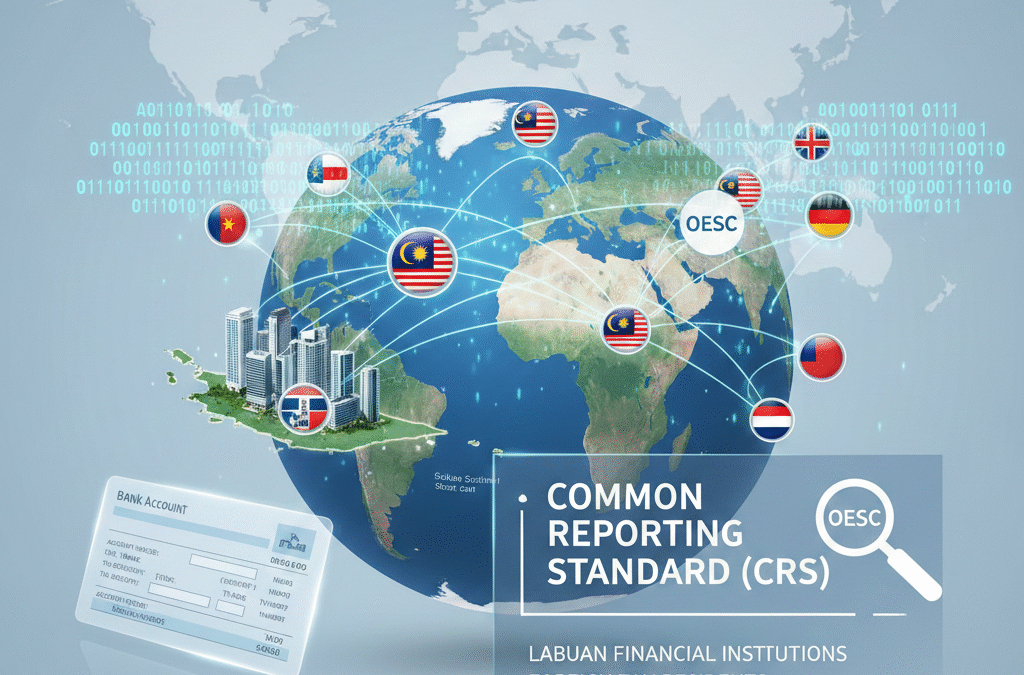
Is a Labuan company CRS (Common Reporting Standard) subject to international tax reporting? Yes. As a member of the global community committed to tax transparency, Malaysia, through the Labuan International Business and Financial Centre (IBFC), has fully implemented these standards.
This means Labuan financial institutions are required to report financial account information of foreign tax residents to the Malaysian authorities, which is then automatically exchanged with partner jurisdictions.
Understanding CRS and Its Global Context
The Common Reporting Standard (CRS) is an international agreement developed by the Organisation for Economic Co-operation and Development (OECD) to combat tax evasion. Under CRS, jurisdictions obtain financial information from their financial institutions and automatically exchange that information with other jurisdictions on an annual basis. As of 2023, over 100 jurisdictions have committed to implementing CRS, creating a global network of tax transparency. The OECD provides comprehensive details about this framework: OECD – Common Reporting Standard.
Labuan’s Commitment to International Standards
Labuan IBFC is not a “blacklisted” tax haven but a reputable international financial centre that complies with global standards. The Labuan Financial Services Authority (Labuan FSA) oversees the implementation of CRS in the jurisdiction. Financial institutions in Labuan, including banks, trust companies, and certain investment entities, are classified as Reporting Financial Institutions. They are legally obligated to identify reportable accounts and submit annual returns to the Malaysian Inland Revenue Board, which acts as the local tax authority. The official stance and guidelines can be referenced here: Labuan FSA – International Standards.
What Information is Reported under CRS?
For accounts held by foreign tax residents, Labuan financial institutions report:
- Personal Data: Name, address, jurisdiction(s) of residence, Tax Identification Number (TIN).
- Account Data: Account number, year-end account balance or value, and in the case of custodial accounts, the total gross amount of interest, dividends, and other income generated.
- Financial Institution Details: The name and identifying number of the reporting Labuan financial institution.
This data is collected through a self-certification process where account holders are required to declare their tax residency status.
Implications for Labuan Company Owners
The practical implications are significant:
- Enhanced Transparency: The ownership and financial activities of a Labuan company are no longer shrouded in secrecy from tax authorities.
- Due Diligence Procedures: When opening a bank or financial account for a Labuan company, the owners and controlling persons will need to provide a self-certification form declaring their tax residency.
- No Impact on Legitimate Business: For legally structured businesses operating in compliance with all relevant tax laws, CRS reporting is a formal administrative procedure and does not create additional tax liabilities.
CRS vs. Other Compliance Frameworks
It is important to distinguish CRS from other international standards. While CRS deals with the automatic exchange of financial account information, other frameworks like the Base Erosion and Profit Shifting (BEPS) project target corporate tax avoidance strategies. Furthermore, a Labuan company may also be required to comply with Economic Substance Requirements, which are separate from CRS but part of the same global move towards transparency. Information on these requirements is available on the Labuan IBFC website: Labuan IBFC – Regulatory Framework.
Navigating the compliance landscape of CRS, economic substance, and other international standards requires careful attention. For company owners, ensuring that all reporting obligations are met accurately is paramount to maintaining good standing. Partnering with a knowledgeable corporate service provider like MCS Corporate Services can help manage these complex requirements, ensuring your Labuan company remains fully compliant with evolving global standards.
Frequently Asked Questions (FAQ)
-
Does CRS mean my home country will tax my Labuan company?
CRS is an information exchange standard, not a direct tax. Whether your home country taxes the income of your Labuan company depends on its domestic tax laws, your tax residency status, and any applicable double taxation agreements. CRS simply provides your tax authority with the information. -
Who is considered a “Controlling Person” of a Labuan company?
A Controlling Person is typically the ultimate beneficial owner(s) who ultimately own or control the company through direct or indirect ownership of over 25% of the shares or voting rights, or who otherwise exercise control over the company or its management. -
Are all Labuan companies automatically reported?
The company itself is not “reported.” Instead, the financial accounts it holds (e.g., bank accounts) are what get reported by the Labuan financial institution to the authorities, with the company’s financial details and information on its controlling persons. -
What happens if I provide incorrect information on a self-certification form?
Providing false or inaccurate information on a self-certification form is a serious offense and can lead to penalties from the financial institution and potentially the regulatory or tax authorities in relevant jurisdictions. -
Is CRS the same as FATCA?
No, CRS is a global standard, while FATCA (Foreign Account Tax Compliance Act) is a US law. However, the principles are similar. A Labuan financial institution may need to report under both regimes if it has US persons as account holders. -
Can a Labuan company avoid CRS reporting?
No, there are no legal loopholes for a Labuan company to avoid CRS if it holds accounts with a Reporting Financial Institution. Attempts to circumvent CRS through complex structures are actively targeted by authorities and carry significant risks.
Important Notice: The regulatory landscape for Labuan offshore companies evolves continuously. The content provided in this blog is intended for general information and should not be construed as legal or professional advice. We strongly recommend that you contact our team to discuss your specific circumstances and obtain accurate, up-to-date information.