Building a sustainable enterprise begins with a critical architectural decision: choosing the right corporate structure. This choice dictates how your company will scale, how it will be taxed, and the extent to which your personal assets are shielded from business liabilities.
Whether your priority is attracting venture capital, optimizing tax efficiency, or pursuing a social mission, understanding the nuances of various legal entities is the first step toward a solid foundation.
What Defines a Corporation?
At its core, a corporation is a legal entity that exists independently of its owners. This “legal personhood” allows the business to own property, enter into binding contracts, and participate in legal proceedings in its own name.
Key Characteristics:
- Limited Liability: Shareholders are typically only at risk for the amount they have invested. Their personal savings and assets are protected from the company’s debts.
- Ownership via Shares: Capital is raised by issuing stock, making it easier to transfer ownership or bring on new investors.
- Perpetual Succession: The corporation continues to exist even if founders or shareholders leave or pass away, providing long-term stability.
Primary Types of Corporations
No single structure fits every business model. The following categories represent the most common paths for incorporation:
1. C Corporation (C Corp)
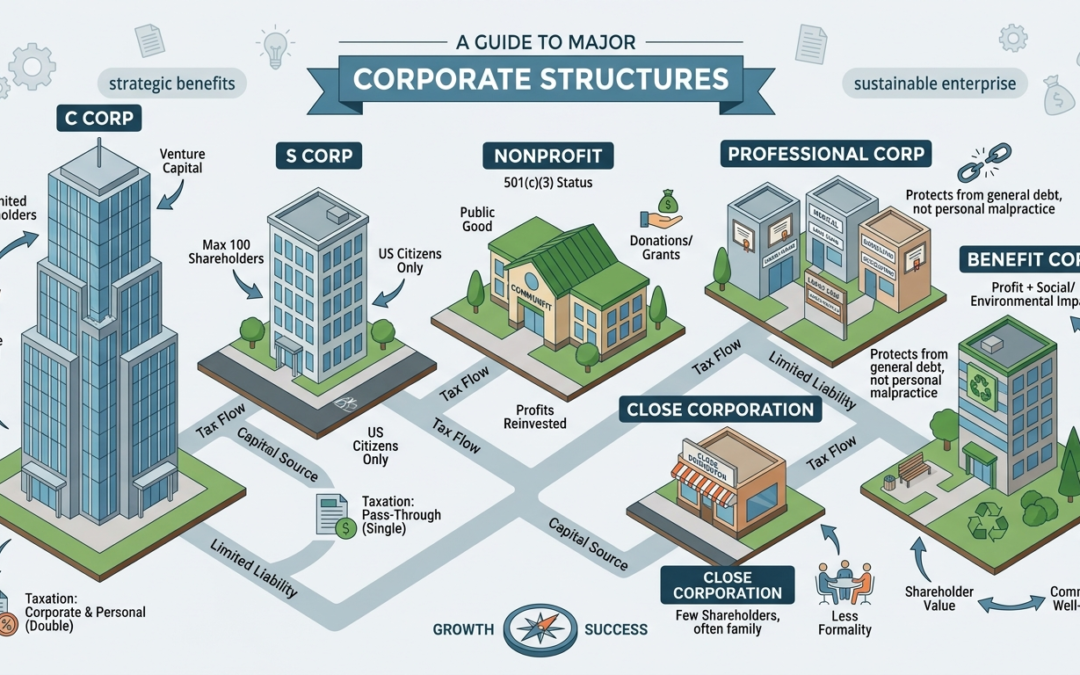
The C Corp is the standard “taxable” corporation. It is the gold standard for high-growth startups and multinational firms because it allows for an unlimited number of shareholders and multiple classes of stock.
- Taxation: Profits are taxed at the corporate level, and dividends are taxed again on the shareholders’ personal returns (often referred to as “double taxation”).
- Best For: Companies planning to go public (IPO) or seek institutional venture capital.
2. S Corporation (S Corp)
An S Corp is a specific tax designation for corporations that meet certain IRS requirements. It provides the same liability protection as a C Corp but changes the tax flow.
- Taxation: Profits and losses “pass through” directly to shareholders’ personal tax returns, avoiding the corporate-level tax.
- Constraints: Limited to 100 shareholders (who must be U.S. citizens or residents) and only one class of stock.
3. Nonprofit Corporation
These entities are formed to benefit the public, a specific group, or a charitable cause rather than to distribute profits to owners.
- Taxation: Eligible for 501(c)(3) status, exempting the organization from federal income tax and allowing donors to claim tax deductions.
- Requirement: All “profit” must be reinvested into the organization’s mission.
4. Professional Corporation (PC)
Designed specifically for licensed professionals—such as doctors, lawyers, and accountants.
- Key Feature: While it protects owners from the general business debts of the firm, it does not typically shield an individual professional from personal malpractice claims.
5. Close Corporation
A “closely held” corporation is ideal for small, family-run businesses. It operates with less formality than a standard corporation, often skipping the requirement for a formal board of directors.
- Control: Ownership is restricted to a small group, and shares are generally not traded publicly.
6. Benefit Corporation (B Corp)
A relatively new legal structure that mandates the company balance profit-making with a positive impact on society or the environment.
- Accountability: Directors are legally required to consider the impact of their decisions on workers, the community, and the environment, alongside shareholder value.
Comparing the Options at a Glance
| Feature | C Corp | S Corp | Nonprofit |
| Taxation | Double Taxation | Pass-through | Tax-exempt |
| Shareholder Limit | Unlimited | Max 100 | N/A (Members) |
| Capital Raising | High (Venture Capital) | Moderate | Donations/Grants |
| Primary Goal | Profit/Growth | Profit/Tax Efficiency | Social/Public Good |
Choosing the Right Path
Selecting a structure requires a forward-looking strategy. Entrepreneurs should ask:
-
How much capital do I need?
C Corps are best for heavy fundraising.
-
Who are my owners?
If you have international partners, an S Corp is not an option.
-
What is my exit strategy?
Selling a business or going public often favors the C Corp structure.
Avoid Common Pitfalls:
Many founders rush the process and neglect ongoing compliance, such as filing annual reports or holding mandatory shareholder meetings. Failing to maintain these formalities can lead to “piercing the corporate veil,” which puts your personal assets back at risk.
How We Facilitate Your Growth
Navigating international regulations, tax codes, and registration requirements can be overwhelming. While we do not disclose specific fixed fees due to the customized nature of each business setup, we provide comprehensive support to ensure your entity is built for success.
Our team assists with:
-
Entity Selection:
Analyzing your specific goals to recommend the most efficient structure.
-
Global Incorporation:
Setting up entities in key jurisdictions including the US, Hong Kong, and Singapore.
-
Ongoing Compliance:
Managing registered agents, annual filings, and bookkeeping so you can focus on your vision.
The best way to determine the exact requirements for your business is through direct engagement.
Since every business journey is unique, a one-size-fits-all approach to incorporation often leads to missed opportunities or costly compliance errors. The most effective way to determine which structure aligns with your long-term vision—and to understand the specific requirements for your industry—is through a direct consultation with our experts. By contacting MCS, you gain access to tailored insights and a clear roadmap for your global expansion, ensuring your enterprise is built on a foundation of strategic excellence and legal integrity.